
Creative Arts Therapy Finder
Discover which creative arts therapy might be most beneficial for your needs based on your situation and preferences.
Step 1 of 3: Your primary concern
Step 2 of 3: Your expression style
Step 3 of 3: Your comfort level
When someone is struggling with trauma, anxiety, or depression, talking about it isn’t always enough. Sometimes the words don’t exist yet. That’s where creative arts therapies step in-not as a replacement for traditional therapy, but as a different path into healing. Through painting, drumming, dancing, or writing, people access emotions they can’t yet name. This isn’t about making beautiful art. It’s about letting the body and imagination speak when the mind is stuck.
What Exactly Are Creative Arts Therapies?
Creative arts therapies are clinical practices that use artistic expression as a tool for emotional, cognitive, and physical healing. They’re guided by licensed therapists trained in both psychology and an art form. These include art therapy, music therapy, dance/movement therapy, drumming therapy, play therapy, and expressive writing. Each one uses a different medium, but they all share the same core idea: creativity bypasses the verbal brain and taps into deeper layers of feeling.
Unlike taking an art class, there’s no right or wrong output. A child’s scribble, an adult’s broken rhythm on a drum, or a trembling movement in dance-all are valid signals. The therapist doesn’t interpret the art. They help the person understand what the art reveals about them.
These therapies are used in hospitals, schools, veterans’ centers, prisons, and private clinics. The American Art Therapy Association reports that over 70% of art therapy programs in the U.S. now serve adults with PTSD, and 60% work with children on the autism spectrum. Music therapy is equally widespread-over 5,000 board-certified music therapists practice in the U.S. alone, according to the American Music Therapy Association.
How Art Therapy Helps When Words Fail
Imagine a veteran who can’t say out loud what happened in combat. Or a teenager who shuts down every time someone asks, “How are you?” In art therapy, they’re given paint, clay, or collage materials and asked to make something-anything-without instructions. The act of choosing colors, shaping clay, or tearing paper becomes a language.
One study from the Journal of the American Art Therapy Association followed 42 adults with PTSD. After 12 weekly art therapy sessions, 78% showed significant reductions in flashbacks and emotional numbness. Why? Because drawing a scene of fear lets the brain process it differently than talking about it. The visual representation creates distance. It turns overwhelming emotion into something tangible you can look at, hold, and slowly understand.
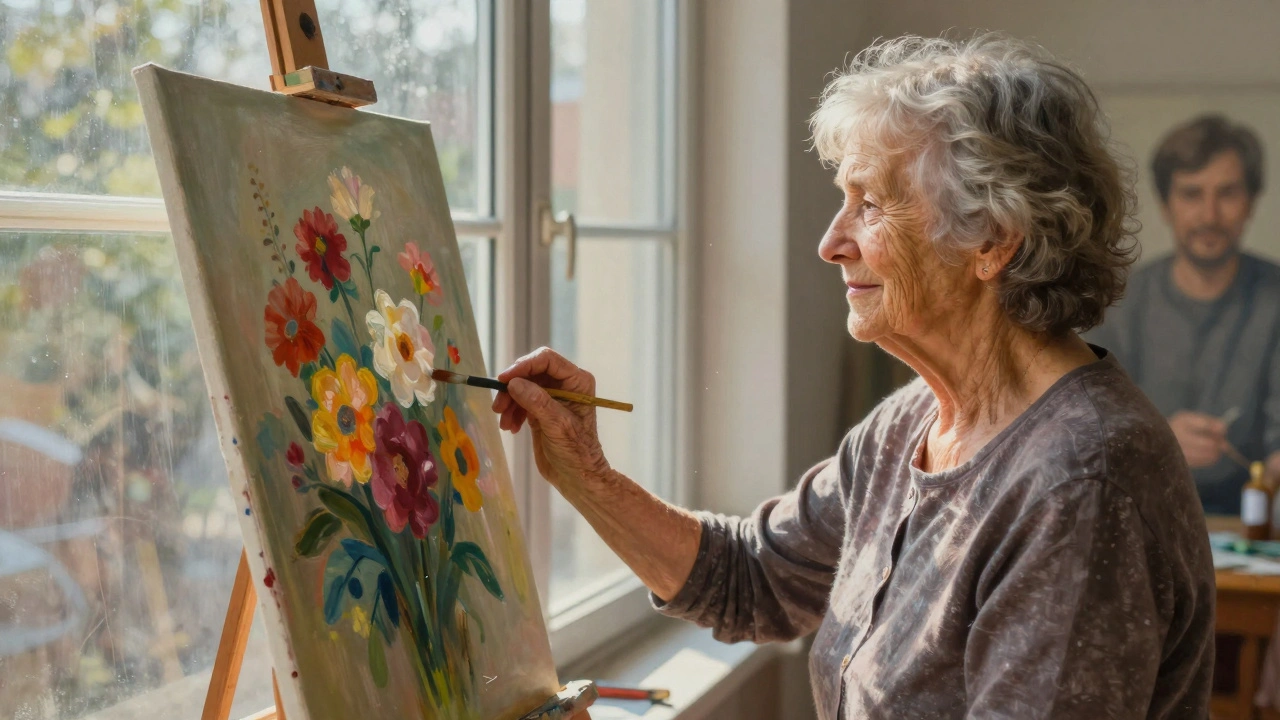
Art therapy isn’t just for trauma. It helps people with chronic illness, dementia, and even grief. A woman in her 70s with Alzheimer’s started painting flowers after her husband passed. Her family noticed she smiled more, spoke in fragments again, and remembered small details about her childhood. The art didn’t cure her dementia. But it gave her a way to reconnect with herself.
Music Therapy: Rhythms That Rebuild Neural Paths
Music doesn’t just move us emotionally-it rewires our brains. Music therapy uses live or recorded music to target specific goals: improving speech after a stroke, reducing anxiety before surgery, or helping autistic children make eye contact.
One powerful example is melodic intonation therapy. It’s used with stroke survivors who’ve lost the ability to speak. Therapists sing simple phrases like “I want water” with a rising melody. Because singing uses the right side of the brain, it can bypass damaged language centers on the left. After weeks of this, many patients begin speaking normally again.
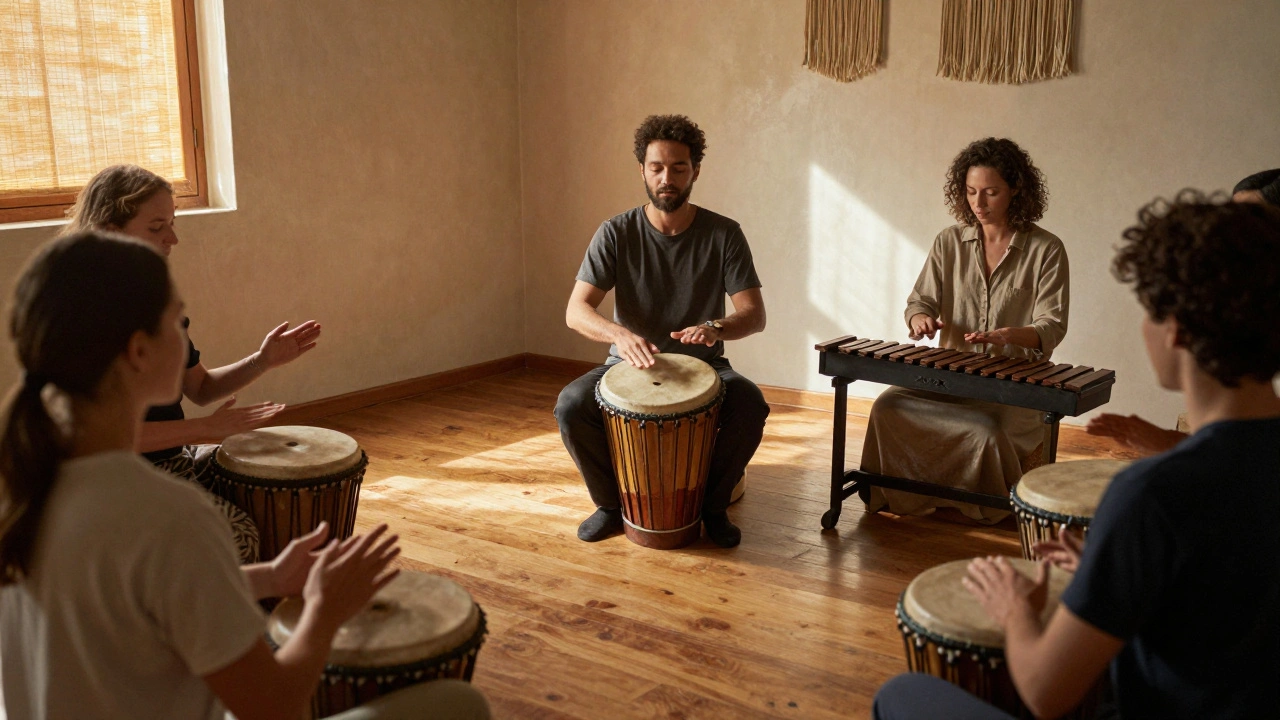
For kids with autism, music therapy often starts with imitation. The therapist plays a rhythm on a drum. The child copies it. Then they take turns. No words needed. Over time, this back-and-forth builds social connection. A 2024 meta-analysis in the Journal of Autism and Developmental Disorders found that children who received weekly music therapy for six months showed a 40% increase in social responsiveness compared to those who didn’t.
Even in hospice care, music therapy helps. A patient lying still might tap their finger to a favorite song from their youth. That small movement can mean everything-it’s a sign they’re still there, still feeling.
Dance and Movement Therapy: Healing Through the Body
When trauma happens, the body remembers it-even if the mind forgets. Dance/movement therapy helps release what’s stuck. It’s not about learning steps. It’s about noticing how your body wants to move.
Someone with anxiety might start by rocking gently in a chair. A therapist mirrors that motion, then slowly expands it-adding arm sweeps, shoulder rolls, foot taps. The person begins to feel safer in their own skin. For survivors of abuse, this can be revolutionary. Many report feeling “whole” for the first time in years.
Studies show dance therapy reduces cortisol levels-the stress hormone-by up to 35% after just eight sessions. It’s especially effective for people with depression. In a 2023 trial with 60 adults diagnosed with major depressive disorder, those who did weekly dance therapy improved as much as those taking antidepressants, but without side effects.
It’s also used in Parkinson’s disease. Patients who struggle with walking or balance often find they can move more freely when dancing. Music cues their rhythm, and the emotional release helps them forget their limitations.
Why These Therapies Work: The Science Behind the Art
There’s real neuroscience behind why creativity heals. When you paint, drum, or dance, your brain releases dopamine-the feel-good chemical. It also activates the default mode network, the part of the brain linked to self-reflection and memory. At the same time, it quiets the amygdala, which controls fear and panic.
Unlike talk therapy, which relies on the prefrontal cortex (the logical part of the brain), creative arts therapies engage the limbic system-the emotional center. That’s why they’re so powerful for people who’ve experienced early childhood trauma or complex PTSD. Their verbal memory is often fragmented. But their body remembers.
Functional MRI scans show that after art therapy, brain activity shifts. Areas tied to emotional regulation light up more. The hippocampus, which shrinks under chronic stress, shows signs of growth. In music therapy, the cerebellum and motor cortex become more connected, improving coordination and emotional control.
This isn’t placebo. It’s measurable change.
Who Can Benefit-and Who Should Try It
These therapies aren’t just for people with diagnosed conditions. Anyone feeling stuck, numb, or overwhelmed can benefit. Teachers under burnout, caregivers of loved ones with dementia, college students facing anxiety-all find relief in creative expression.
But not everyone needs the same approach. Here’s who tends to respond best:
- Art therapy: People who are visual thinkers, struggle with verbal expression, or feel ashamed of their emotions.
- Music therapy: Those who respond strongly to rhythm, have speech difficulties, or respond to memory through sound.
- Dance/movement therapy: Individuals who disconnect from their bodies, carry tension in their shoulders or hips, or feel trapped in their thoughts.
- Expressive writing: People who prefer solitude, are comfortable with words, or need to process grief or loss.
You don’t need to be “artistic.” You don’t need talent. You just need to be willing to try something new. A 2025 survey by the National Institute of Mental Health found that 68% of people who tried creative arts therapy for the first time were skeptical-yet 82% said they’d do it again.
Getting Started: What to Expect
First session? Don’t overthink it. You’ll meet a licensed therapist who’ll ask about your goals. Then you’ll be given materials: crayons, a drum, a journal, or space to move. There’s no pressure to produce anything. The focus is on how you feel while creating.
Some people cry. Others laugh. Some sit quietly for the whole hour. All are normal. Progress isn’t measured by how “good” the art looks. It’s measured by whether you feel lighter, clearer, or more connected afterward.
Most programs run weekly for 8-12 weeks. Insurance sometimes covers it if the therapist is licensed and the treatment is for a diagnosed condition. Many community centers and nonprofits offer sliding-scale fees or free sessions.
What Doesn’t Work
Creative arts therapies aren’t magic. They won’t fix everything overnight. They also aren’t a substitute for medication or emergency care. If someone is in crisis, they need immediate support first.
And not every therapist is the right fit. If you feel judged, rushed, or misunderstood, it’s okay to try someone else. Trust matters more than the technique.
Also, avoid “DIY” versions of these therapies. Coloring books or YouTube dance videos can be relaxing-but they’re not therapy. Without a trained professional to help you process what comes up, you might get stuck in old patterns instead of moving through them.
Where This Is Headed
Creative arts therapies are growing fast. In 2025, the U.S. Department of Health and Human Services added them to its list of recommended treatments for veterans with PTSD. Schools in California and New York now include art and music therapy in their special education programs. Hospitals are hiring therapists for oncology wards and labor units.
The future isn’t just about adding more programs. It’s about recognizing that healing doesn’t always come from talking. Sometimes it comes from painting a storm, drumming out grief, or dancing like no one’s watching-because in that moment, you’re not just creating art. You’re reclaiming yourself.
Are creative arts therapies backed by science?
Yes. Over 1,200 peer-reviewed studies since 2000 show measurable improvements in anxiety, depression, PTSD, and cognitive function. Brain scans, hormone levels, and behavioral assessments confirm these therapies trigger real neurological changes-not just temporary mood boosts.
Do I need to be good at art or music to benefit?
No. Creative arts therapies aren’t about skill. They’re about expression. A child’s scribble, a shaky drumbeat, or a single tear while writing can be just as meaningful as a masterpiece. The therapist’s job is to help you understand what your creation reveals-not to judge it.
Can these therapies replace medication?
Not usually. They work best alongside other treatments like counseling or medication. For some people with mild depression or anxiety, creative arts therapy alone can be enough. But for severe conditions, combining therapies gives the best results. Always consult your doctor before changing any treatment plan.
How long does it take to see results?
Some people feel a shift after one session. Others need 6-8 weeks. It depends on the issue, the person, and how often they attend. Consistency matters more than intensity. Weekly sessions over 10-12 weeks typically lead to lasting change.
Is creative arts therapy covered by insurance?
It depends. Many insurance plans cover it if the therapist is licensed (e.g., ATR-BC, MT-BC) and the treatment is for a diagnosed condition like PTSD, autism, or depression. Medicare and Medicaid sometimes cover it in clinical settings. Check with your provider and ask for a pre-authorization.