
When was the last time you walked barefoot on grass, sat under a tree without checking your phone, or just listened to birdsong for ten minutes? If it’s been weeks-or worse, months-you’re not alone. But you might be missing one of the simplest, cheapest, and most powerful tools for mental well-being: nature.
What Happens in Your Brain When You Walk in the Woods
Your brain doesn’t see a forest as just trees and dirt. It sees safety. Evolution shaped us to feel calm in natural settings. Studies from Stanford University found that people who walked for 90 minutes in a natural area showed reduced activity in the subgenual prefrontal cortex-the part of the brain linked to rumination, the endless loop of negative thoughts that fuels anxiety and depression. Those who walked the same amount of time in a busy urban setting showed no such change.
This isn’t just about quiet. It’s about sensory input. In cities, your brain is constantly filtering out noise, lights, traffic, and demands. In nature, the stimuli are softer. The rustle of leaves, the rhythm of wind, the uneven path underfoot-they don’t demand attention. They invite it. That shift from directed attention to soft fascination gives your mental resources a chance to reset.
Forest Bathing Isn’t a Trend-It’s a Treatment
Originating in Japan in the 1980s, shinrin-yoku, or forest bathing, isn’t about exercise or hiking to a summit. It’s about slow, mindful presence in a forest. You don’t need to be fit or experienced. You just need to be there.
Researchers at the Nippon Medical School found that people who spent two hours in a forest setting had significantly lower levels of cortisol, the stress hormone. They also saw increases in natural killer (NK) cell activity-part of your immune system that fights tumors and viruses. The boost lasted for over a week after the visit.
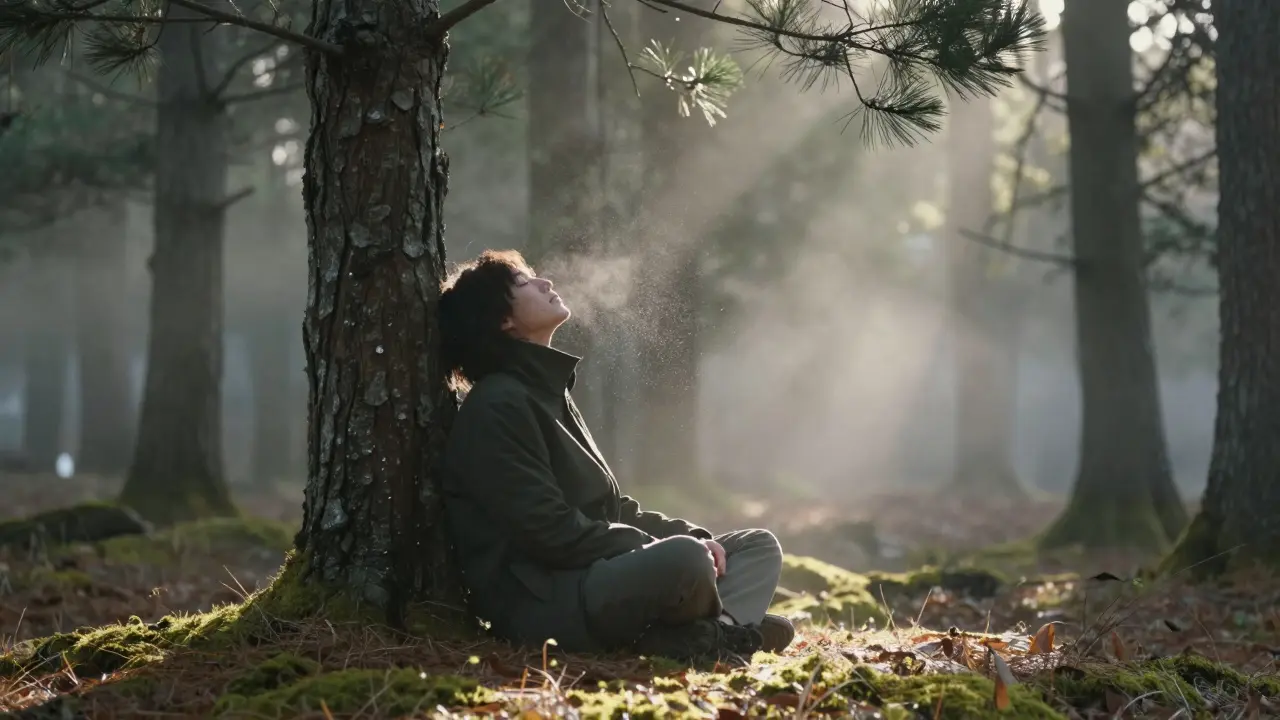
Why? Trees release compounds called phytoncides. These are natural oils that protect them from insects and rot. When you breathe them in, your body responds by lowering stress and boosting immunity. You don’t need to know the science to feel it. You just need to stand under a pine tree and take three deep breaths.
You Don’t Need a National Park
Many people think they need to drive hours to find nature. That’s not true. A 2021 study from the University of Exeter analyzed data from over 20,000 people across the UK and found that spending just two hours a week in nature-whether it’s a park, a garden, a riverbank, or even a tree-lined street-was linked to higher self-reported well-being.
That’s not two hours in one day. It’s two hours total, broken up however you can. Ten minutes after work. Thirty minutes on your lunch break. An hour on Sunday morning. It adds up.
Even small green spaces matter. A study in Philadelphia showed that when vacant lots were cleaned up and turned into small parks, nearby residents reported lower levels of depression and stress. You don’t need a forest. You need access to green.
Why Nature Helps More Than a Movie or a Video Game
When you’re feeling low, it’s tempting to scroll, binge-watch, or play a game. These things distract you-but they don’t restore you. They keep your brain in overdrive.
Nature works differently. It doesn’t demand your focus. It doesn’t reward you with dopamine hits. It doesn’t ask you to react. It simply lets you be. That’s why it’s so effective for people with ADHD, PTSD, and chronic anxiety. A 2019 meta-analysis of 143 studies concluded that nature exposure had moderate to large effects on reducing symptoms of anxiety and depression, especially when combined with physical movement.
And it’s not just about mood. People recovering from surgery who had a view of trees needed fewer painkillers and were discharged sooner than those who looked out at brick walls. That’s not placebo. That’s biology.
How to Start-Even If You’re Busy or Skeptical
You don’t need to quit your job and move to the mountains. Here’s how to make nature part of your routine, even if you think you don’t have time:
- Start with five minutes. Step outside right after you wake up. Feel the air. Look at the sky. Don’t talk. Don’t check your phone. Just be.
- Turn your walk into a nature walk. Instead of listening to a podcast, listen to birds, wind, or footsteps on gravel.
- Keep a nature journal. Write down one thing you noticed each day-a flower, a cloud shape, the way light hit a puddle. It trains your brain to notice beauty.
- Bring nature inside. Open your windows. Keep a plant on your desk. Play recordings of rain or ocean waves while you work.
- Make it social. Walk with a friend and agree to not talk for the first 10 minutes. Just walk together in silence.

The Hidden Cost of Not Getting Outside
People who live in urban areas with little green space are 20% more likely to develop depression and 30% more likely to develop anxiety, according to data from the World Health Organization. This isn’t just about personal preference. It’s a public health issue.
Children raised without access to nature show higher rates of ADHD and lower attention spans. Older adults who spend time outdoors have slower cognitive decline. People with chronic pain report less intensity when they spend time in gardens.
And yet, most mental health treatments still focus on medication and talk therapy-both valuable-but they often ignore the environment. Nature isn’t a luxury. It’s a baseline need, like sleep or water.
What Science Says About Water
It’s not just trees. Blue spaces-lakes, rivers, oceans, even fountains-have their own powerful effects. A study in the journal Environmental Science & Technology found that people who lived near the coast reported better mental health than those living inland, even after controlling for income, education, and physical activity.
The sound of water triggers a relaxation response in the brain. It’s rhythmic, predictable, and non-threatening. That’s why white noise machines use ocean sounds, not car horns.
If you live near water, make it part of your routine. Sit by a river during lunch. Walk along a canal after dinner. Even a small fountain in a city square can help.
It’s Not About Perfection
You don’t need to go on a week-long retreat. You don’t need to live in the countryside. You don’t need to be a nature lover. You just need to step outside-once a day, even if it’s cold, even if it’s raining, even if you don’t feel like it.
Nature doesn’t judge. It doesn’t ask you to be productive. It doesn’t remind you of your to-do list. It just is. And sometimes, that’s exactly what your mind needs.
How much time in nature do I need to see mental health benefits?
Research shows that just two hours per week spent in nature-whether all at once or broken into smaller chunks-significantly improves mood and reduces stress. You don’t need to be in a wilderness area; even urban parks count.
Can nature help with anxiety and depression?
Yes. Multiple studies, including meta-analyses from universities like Stanford and Exeter, show that regular exposure to green and blue spaces reduces symptoms of anxiety and depression. The effects are comparable to mild medication or therapy for some people, especially when combined with movement like walking.
Does it matter if I’m alone or with others in nature?
You benefit either way. Being alone lets your mind quiet down. Being with others-especially without screens or conversation-can deepen connection and reduce loneliness. The key is presence, not company.
What if I live in a city with no parks nearby?
Look for any green space: a community garden, a tree-lined sidewalk, a rooftop with plants. Even looking at nature through a window helps. Studies show that hospital patients with views of trees recover faster. You can also use nature sounds, indoor plants, or nature photography to mimic the effect.
Is forest bathing the same as hiking?
No. Hiking is goal-oriented: reach the summit, cover distance, get exercise. Forest bathing is about slowing down, using your senses, and being present. You might walk less than a mile. You might sit still for 20 minutes. The goal isn’t movement-it’s connection.